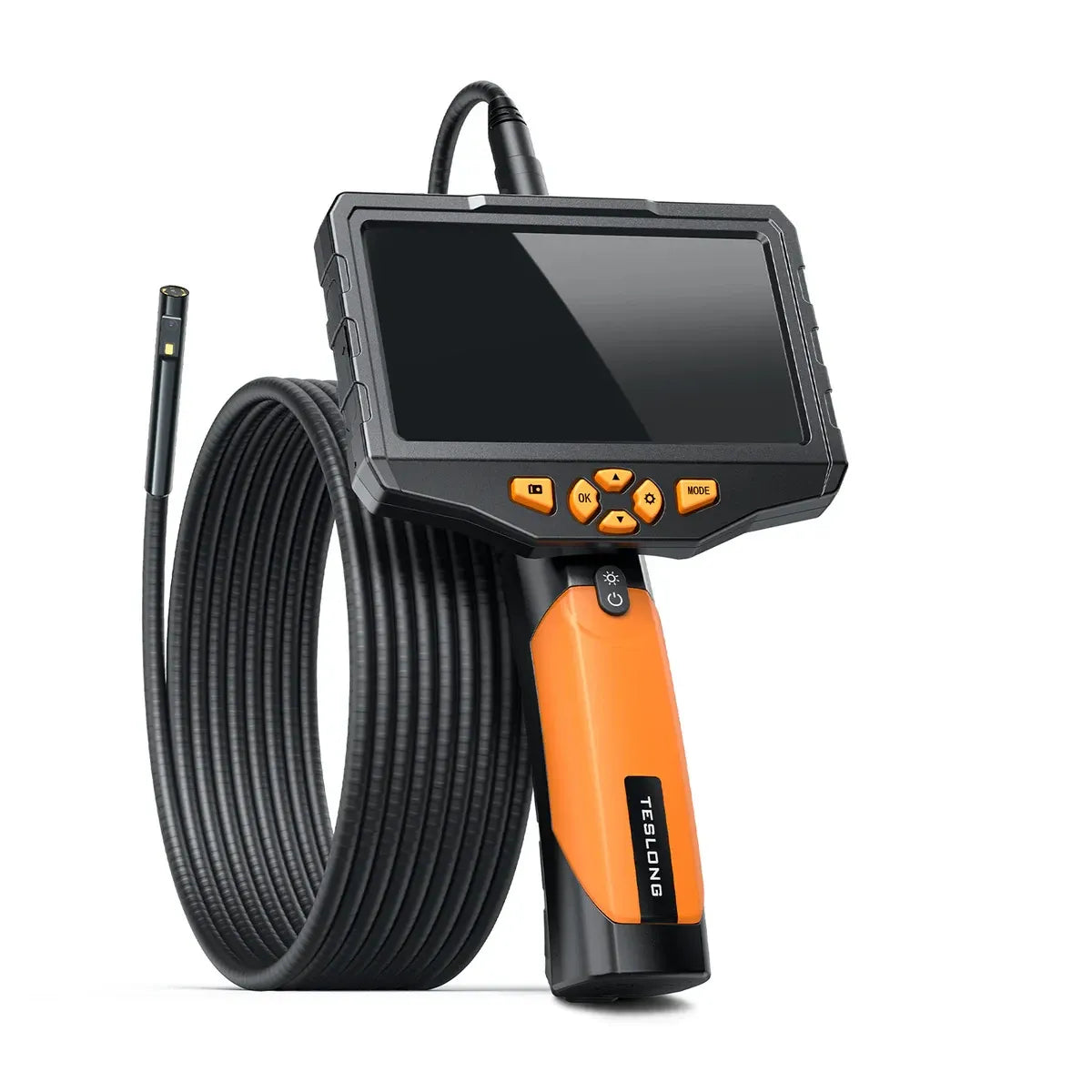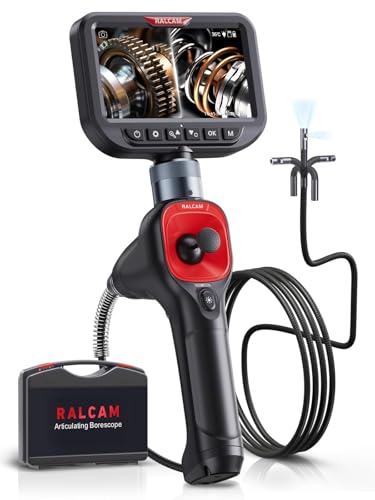
Dual lenses change the viewing direction. Articulation changes the position of the camera head. Choose according to the target, the route and the room available to move.
Two lenses do not mean a moving head
A typical dual-lens inspection camera has a forward-facing lens and a fixed side-facing lens. Selecting the side lens lets you look towards a nearby wall or component without pointing the front lens directly at it. The head itself stays in the same position, and the useful side view still depends on focus distance and orientation.
An articulating probe bends the camera head using a control. Some move in one plane; others have more directions of movement. Dual lenses and articulation can exist on the same device, as illustrated by the Sanyipace model reviewed by HighTechDad. Check the actual controls and lens arrangement instead of assuming the terms are interchangeable.
Steering still needs clearance
The Drive's Teslong TD450S review describes steering in one plane and twisting the cable to obtain another viewing direction. During its route towards a turbocharger, the author still found centring and aiming difficult. Articulation improved control, but it did not remove the limits imposed by the access path.
The straight head diameter is only one part of the fit. A bent head occupies a larger envelope, and a rigid section needs room to swing. Check the clearance beyond the opening as well as the opening itself. Do not pull back an articulated tip through a narrow entrance while it remains bent.
Match the mechanism to the target
For a nearby cylinder wall, a fixed side lens may provide the required view if the head can reach a suitable position. Looking back towards a valve or around an awkward edge may require a different angle, but the precise engine geometry determines whether an articulating head can achieve it. A feature label cannot establish vehicle-specific access.
Digital Camera World found the Rove RS2's movement reduced when the cable was bent. Its reviewed sample also differed from a later advertised articulation angle. Ask which version was reviewed, and judge movement in the intended cable shape rather than from a straight probe photographed on a table.
- Forward target: check front-lens focus and access.
- Side target: check side-lens focus and rotation.
- Target behind an edge: check steering direction and space to bend.
- Narrow withdrawal route: confirm the tip can return fully straight.
Compare the complete inspection, not the angle label
A useful demonstration shows the entrance, cable route, head movement and saved target image together. A large advertised steering angle is less valuable if the target cannot be brought into focus or the cable cannot be controlled from the working position.
Ask to see the head straighten and the probe withdraw after the image is captured. Avoid treating a sample review's short use period as proof of steering-cable durability. The Drive explicitly describes limited hours with the TD450S and no side-by-side comparison; its review is an access and handling reference, not a lifetime test.
Sources & further reading
These are external published reviews or specialist guidance. Their observations are attributed; they are not our own physical tests. Source availability and hardware may change.